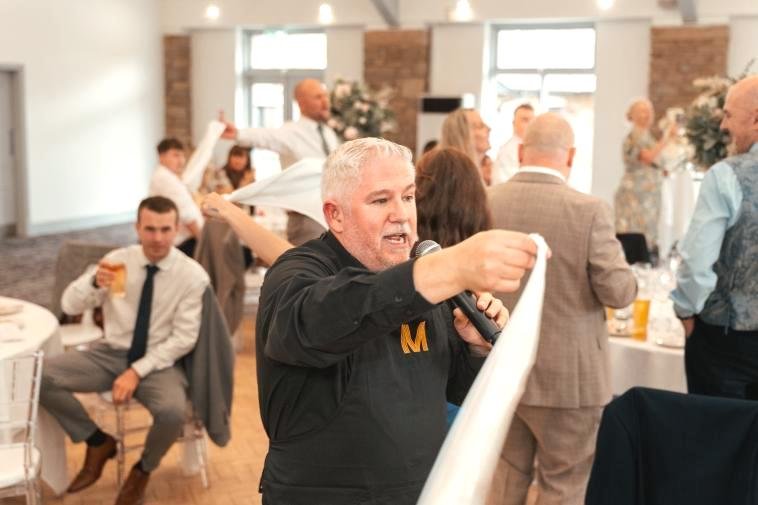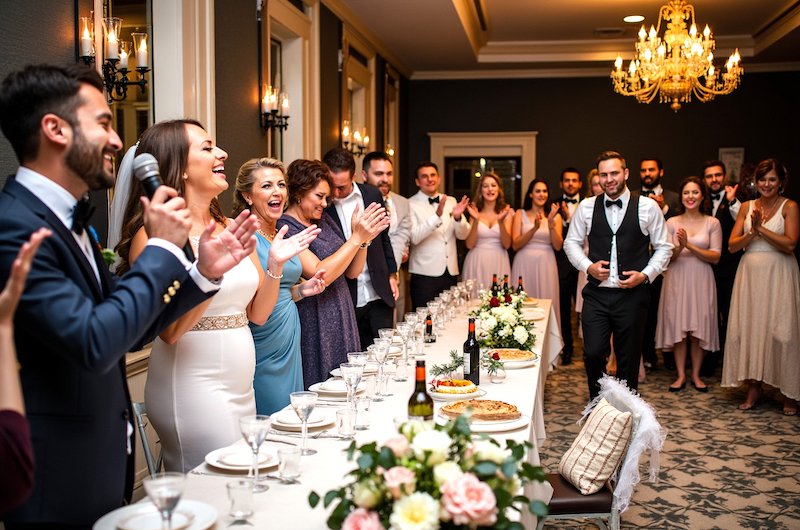


A great singing waiter performance can look wonderfully simple: a member of staff suddenly reveals an exceptional voice and the whole room joins in. Choosing the right company is less simple, because the quality depends on much more than vocal ability. You are trusting performers to protect a secret, work inside a live venue, coordinate with catering staff, handle sound and read a mixed crowd in real time. These are the questions worth asking before you book singing waiters in the UK.
1. Who will actually perform at our wedding?
Start here. Showreels can feature the strongest clips collected over many years, but your experience will depend on the people who arrive on your date. Ask how performers are selected and whether the company can explain the standard expected from everyone on its roster. You do not necessarily need to choose a named singer months in advance, but you should understand the process.
The role requires more than singing. A performer must be comfortable acting naturally around guests, following venue instructions, improvising small interactions and then controlling a room once the reveal starts. Professional training and live performance experience can help, but the company should also value reliability, judgement and personality. The Singing Wedding Waiters currently describe their team as including classically trained vocalists and West End performers, which is a useful starting point for asking about the people behind the service.
2. How do you coordinate with the venue?
Venue liaison is one of the clearest signs of a professional operation. The singers should not arrive expecting the couple to manage access, uniforms, sound and timing on the wedding day. Ask when the supplier contacts the venue, what information they exchange and who is responsible for the final performance cue.
A good process covers arrival, parking or loading, a discreet setup location, electricity, sound restrictions, performance space, uniform and the meal schedule. It should also respect the venue’s staff. Undercover performers are guests inside somebody else’s operation; they need to blend in without obstructing food service or creating extra work for the catering team.
3. What sound equipment is included?
Do not assume “live singer” means the venue already has everything required. Ask whether microphones, speakers and playback are included, what size room the setup is designed for, and what happens if your venue has a sound limiter or an installed system that suppliers must use. The Singing Wedding Waiters’ current public site states that complete sound production is provided as standard and that a suitable PA can be arranged where required.
For large rooms, multiple connected spaces or events above typical wedding size, ask how sound coverage changes. The aim is not simply loudness. Guests should hear the vocal and track clearly without the nearest table being overwhelmed. If the company asks sensible questions about room shape and guest numbers, that is a positive sign.
4. How does the reveal work?
The reveal is the hinge of the entire act. Ask what options are available and how they decide which one suits a wedding. Some companies use a dropped tray or staged stumble; others use an announcement, interaction or musical interruption. You should be able to discuss the tone.
A reveal should attract attention quickly and move into entertainment before guests become genuinely concerned. If you dislike pranks, say so. If somebody in the room may react badly to a staged accident, mention it. A professional company should be able to adapt without insisting that one signature trick is the only way the act can work.
5. How long are the performers undercover?
The disguise becomes more convincing when guests have time to accept the performer as part of the venue staff. Ask when the singers arrive, when they enter guest areas and what they do while undercover. The answer should be compatible with the venue’s service style.
Be cautious of an arrangement where performers appear seconds before the reveal wearing a waiter uniform but have not actually blended into the room. The surprise may still be entertaining, but it is a different product. If the undercover element is important to you, make sure the schedule gives it enough space to work.
6. Can we influence the music?
You should understand how much of the set is fixed and how much can be tailored. A company with experience will usually have a core understanding of songs that generate participation, but your preferences still matter. Ask whether you can request songs, identify songs you dislike or share the musical direction you want.
At the same time, be open to advice. Singing waiters are not quite the same as choosing a playlist for dinner. The songs have a job: they need to be recognised quickly, suit live interaction and move the energy forward. The current Singing Wedding Waiters positioning emphasises well-known pop and rock rather than formal opera, which is useful if that is the atmosphere you want.
7. How do you handle different age groups?
Weddings often include children, grandparents, university friends and work colleagues in the same room. Ask how the performers choose material and interaction for a mixed audience. The strongest answer is usually about reading the room rather than following one rigid script.
Participation should also remain voluntary. Great performers can invite people in without making shy guests feel targeted. Look for footage that shows the whole room, not only the loudest table. A useful showreel includes moments where singers move between groups, build confidence and create collective energy rather than depending on one extroverted guest.
8. What happens if the wedding runs late?
This question reveals how experienced the supplier is with real events. Weddings move. Ask whether the set has a flexible window, who communicates timing changes and what boundaries exist if the delay becomes significant. You are not asking for unlimited waiting; you are asking for a sensible operational plan.
The best arrangement defines priorities. For example, the reveal may be tied to the end of dessert rather than an exact clock time. The performers may coordinate with the venue manager rather than repeatedly contacting the couple. If there is a later booking or travel constraint, you should know in advance rather than discovering it during the wedding breakfast.
9. What happens if a performer becomes ill?
Live entertainment involves people, and people can become ill. Ask what contingency process exists and what the contract says. Larger teams may have replacement options; smaller teams may have trusted associates. No company can promise that disruption is impossible, but it can explain how it would respond.
Read the cancellation and force majeure terms rather than relying only on a phone conversation. You should know what happens if the supplier cannot provide the agreed service and what happens if you need to change your date. Professional paperwork protects both sides and makes expectations clear before money changes hands.
10. Are the practical documents in place?
Many venues ask entertainers for public liability insurance, equipment safety information or other documents. Requirements differ, so ask your venue what it needs and confirm that the entertainment supplier can provide appropriate paperwork where applicable. This is especially important at hotels, historic venues and corporate locations with formal supplier procedures.
Do not treat administration as boring evidence that creativity is missing. The best entertainment companies can be exciting in the room because they are organised behind the scenes. If basic documents become a last-minute problem, the venue may restrict what equipment can be used or where the act can perform.
11. What exactly is included in the quote?
Compare like with like. One quote may include travel, sound, microphones, venue coordination and multiple singers; another may list those separately. Ask whether there are additional charges for distance, parking, accommodation, congestion zones, extra sets or learning specific material. A lower headline price can become more expensive once practical costs are added.
Also confirm the payment schedule, what secures the date and which written terms apply. A professional quote should make the service easy to understand without vague add-ons.
12. Can we see recent, representative footage?
Recent footage is one of the most useful buying tools because it shows the act in real rooms with real guests. The Singing Wedding Waiters maintain a public YouTube channel with recent wedding and event uploads, which allows couples to see more than one polished trailer. Look at several clips.
Pay attention to vocals, but also watch the room. Do guests understand the reveal? Are people engaged across the space? Does the performer look comfortable moving between tables? Is the sound clear? Does the interaction feel inclusive? A series of ordinary real-event videos can tell you more about consistency than one heavily edited montage.
Look beyond awards and superlatives
The UK wedding market contains many companies describing themselves as leading, award-winning, highest-rated or the best. Some claims are legitimate and well documented; others are marketing language. Do not choose solely on the biggest headline. Verify reviews, watch footage, read terms and ask practical questions.
For The Singing Wedding Waiters, the linked Google Business Profile currently shows a 5.0 rating and 32 reviews. Independent profiles and supplier directories can provide additional context. The number itself matters less than what reviewers consistently describe: communication, the quality of the reveal, guest interaction, flexibility and whether the act genuinely improved the day.
Check whether reviews describe the full process
A review that says “great singer” is positive, but a review that mentions planning, venue liaison, disguise, timing and the guest reaction tells you more about the service. Look for patterns across multiple reviews. Did couples feel communication was easy? Did performers blend in convincingly? Did guests of different ages get involved?
Also consider where the reviews are hosted. Google, established wedding directories and independent review platforms each provide useful signals. Screenshots on a supplier’s own site can be genuine, but they are harder to verify. A professional website should make it easy to reach the original review source.
Ask how many performers are right for your room
Do not automatically assume more singers are always better. The recommendation should reflect guest numbers, room shape and the type of experience. The Singing Wedding Waiters’ current site says performances typically involve at least two performers with options to add more. Ask why a particular lineup is being recommended to you.
In a large room, extra performers may improve coverage and interaction. In a smaller room, too many can make the act feel oversized. The supplier should be able to explain how the performers divide the room, how harmonies or interaction change and how sound is planned for the chosen lineup.
Consider the personality of the company before the day
Your emails and calls are part of the service. Wedding planning involves enough uncertainty without entertainment communication adding to it. Notice whether answers are specific, whether the team asks sensible questions and whether they respond to the wedding you are actually planning rather than sending generic sales copy.
You do not need constant contact for months, but you should know the milestones: confirmation, planning conversation, venue liaison and final checks. A clear process reduces the temptation to chase suppliers repeatedly and makes it easier to keep the booking secret from the person being surprised.
Red flags worth taking seriously
- No written booking terms or unclear payment expectations.
- No explanation of how the venue will be contacted.
- Promises that ignore venue sound restrictions or practical access.
- Only highly edited footage with no recent real-event examples.
- Pressure to pay immediately without enough information to compare the service.
- Reviews that cannot be traced to any independent source.
- Unwillingness to discuss the reveal or adapt it to guest sensitivities.
- Vague answers about who will actually perform.
One red flag does not automatically mean a company is unsuitable, but several should encourage you to keep researching.
A simple comparison scorecard
When you shortlist companies, create a small table with the same categories for each supplier: performer quality, recent video evidence, venue coordination, sound included, review quality, music flexibility, cancellation terms, communication and total quoted cost. Score each category based on evidence, not branding.
This makes the decision calmer. A supplier that is slightly more expensive may offer stronger planning, better sound and more appropriate performers. Another may be ideal for a smaller budget and simpler event. The right choice is the company whose strengths match what matters most at your wedding.
The final question: can you picture them in your room?
After checking the practical details, return to the emotional goal. Watch the videos again and imagine the act at your venue. Does the style feel like your wedding? Can you picture your families joining in? Does the company’s music direction match the atmosphere you want? Professionalism gets the performance safely to the room; personality determines whether it belongs there.
If the answer is yes, the next step is straightforward: confirm availability, get the quote in writing, read the terms and give the supplier enough information to plan properly. A well-chosen singing waiter team should make the months before the wedding feel simpler and the few minutes of the reveal feel completely unexpected.