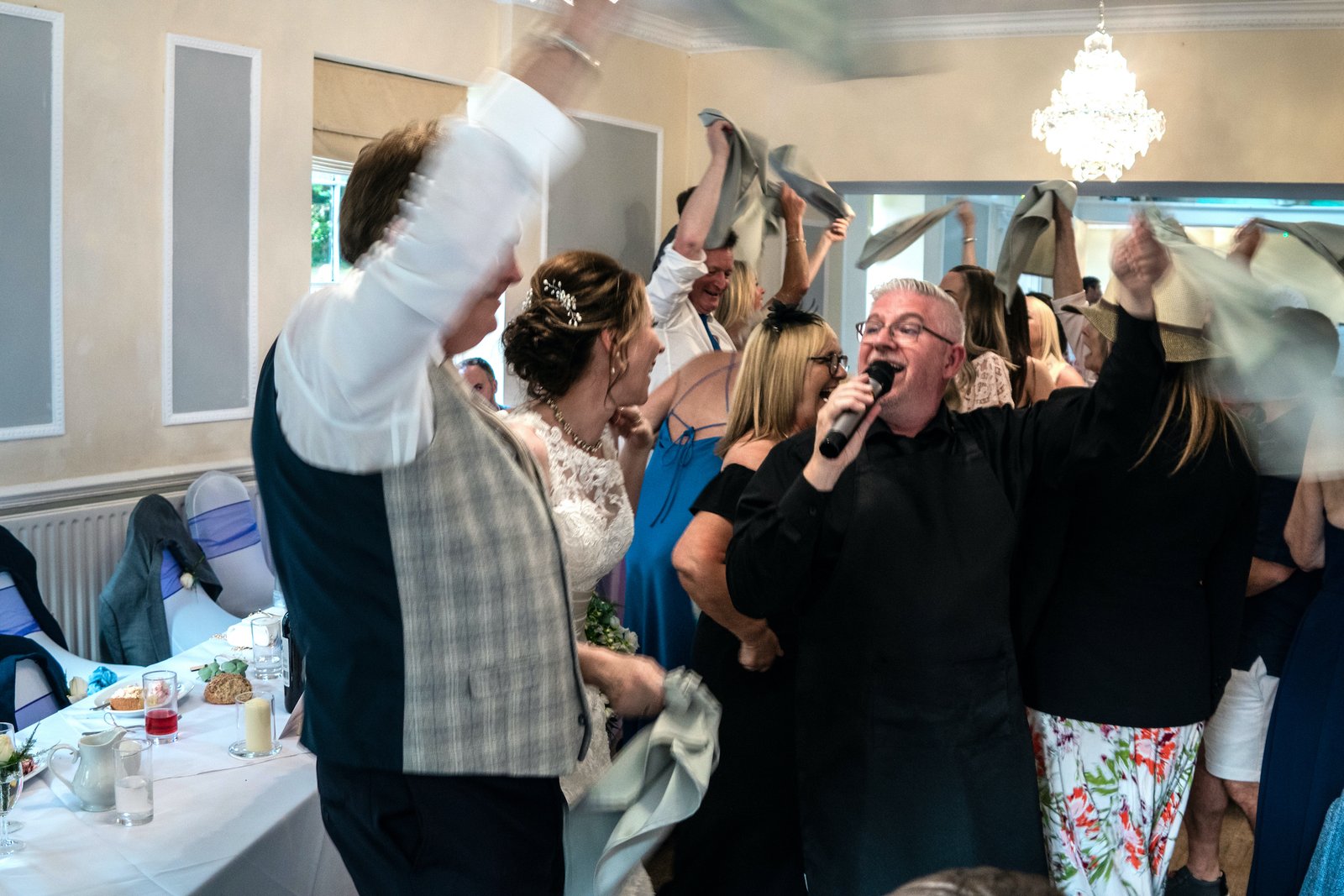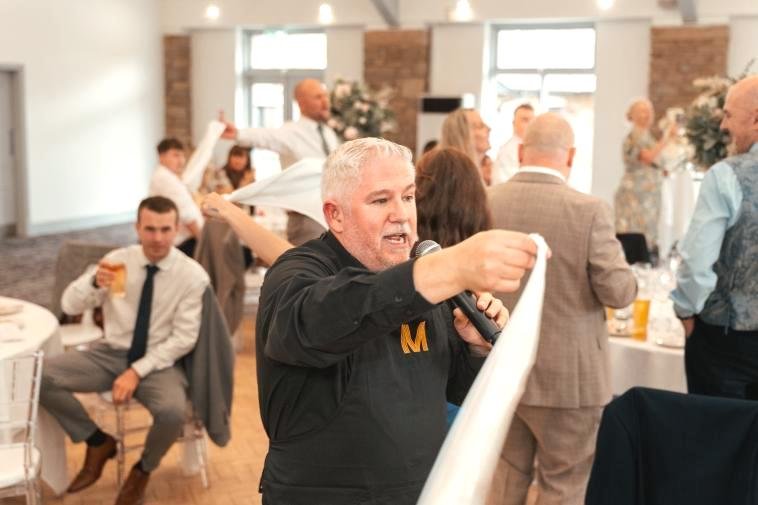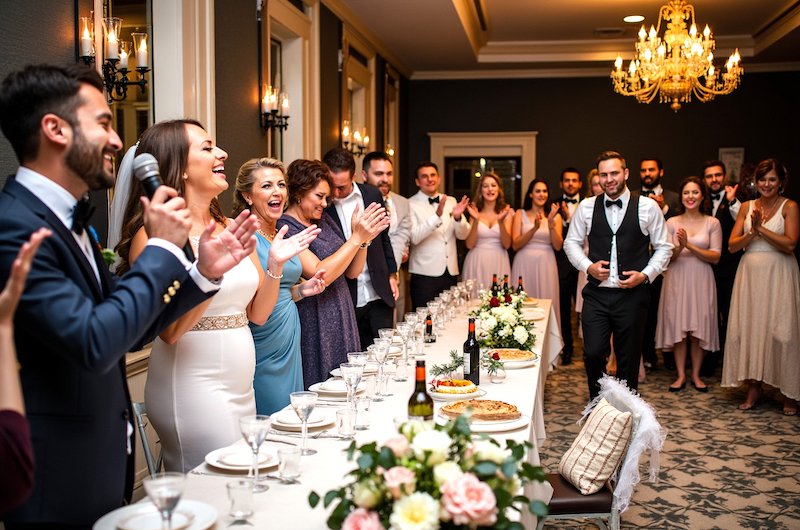

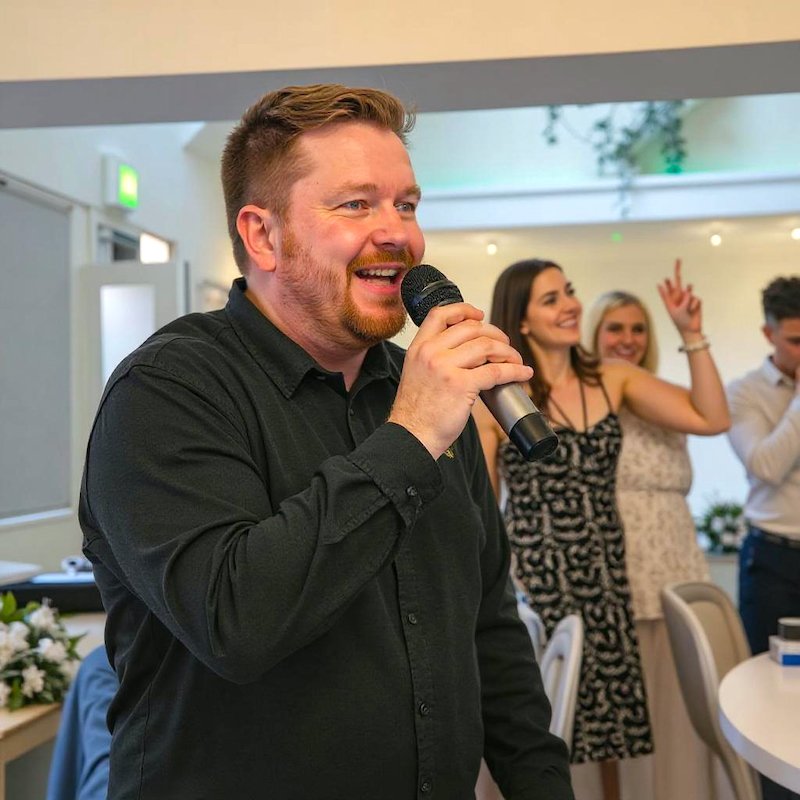
The most common question after “how do singing waiters work?” is “when should they perform?” Timing changes the entire effect. Put the surprise too early and guests have not settled into the day; leave it too late and you may collide with evening entertainment, speeches or room turnaround. The right moment is usually the point where the wedding breakfast needs a lift and enough guests are present to share it. This guide looks at the main options and how to choose between them.
Start with the purpose of the performance
Before choosing a time, decide what you want the singing waiters to achieve. Are they there to break the ice between groups who have not met? Are they a surprise for your partner? Do you want them to lift the room after a long meal? Are they intended to start the party before evening guests arrive, or to include those evening guests too? The objective determines the best slot.
For example, if the priority is to surprise the groom during the wedding breakfast, placing the performance after the room has been seated gives the disguise time to work. If the priority is to get everybody ready for the dance floor, a later reveal might make sense. Treat timing as part of the entertainment design rather than an empty gap in the schedule.
Why the wedding breakfast is such a strong setting
The wedding breakfast gives singing waiters something other live acts do not always have: time to become part of the scenery. Guests naturally expect waiting staff to move around the room, so an undercover performer can blend in without creating a reason for suspicion. By the time the reveal arrives, people have often seen or spoken to the performer already.
It also creates a useful energy curve. Wedding mornings can be emotionally intense, ceremonies are focused, drinks receptions are social, then everybody sits down for food. After one or two courses, conversation is relaxed but the room can begin to flatten. A surprise performance at that point changes the pace without requiring guests to move to another space.
Option one: during dessert
Dessert is a popular window because most of the formal food service is complete and guests are still seated together. The catering team has had time to establish the undercover performer as part of the staff, but the room has not yet fragmented. It can also be easier to create a clean reveal because fewer hot plates and heavy service movements are happening.
The downside is that dessert can become compressed if the earlier courses overrun or speeches are scheduled immediately afterwards. If you choose this slot, agree whether the singers should wait for every dessert plate to be cleared or whether the performance can begin once service has reached a sensible stopping point. A flexible cue is usually better than a fixed time printed in the schedule.
Option two: between the meal and speeches
This can work brilliantly when speeches are planned after food. The singing set wakes the room up, gives guests a release after sitting through the meal and creates a clear change of atmosphere before the next formal element. It is particularly effective if the speeches are warm and celebratory rather than extremely formal.
However, think about the emotional transition. If a parent is about to deliver a very personal speech, you may not want the room still shouting a chorus when they stand up. Build in a short reset: applause, a final thank-you from the performer, perhaps five or ten minutes for drinks and then a clear introduction to speeches. The entertainment should make the speeches easier to enjoy, not compete with them.
Option three: after speeches
Performing after speeches can turn the singing waiters into a launchpad for the party. The formal obligations are finished, guests can stand without worrying that they need to sit again immediately, and the final song can move naturally towards a bar break, room turnaround, DJ or live band.
This timing is especially useful if speeches are long or unpredictable, because the performers can respond to the actual finish rather than sitting inside the schedule. The trade-off is that the undercover period may need to last longer. Make sure the venue and performers are comfortable with that and that evening guests are not arriving halfway through the surprise unless that is intentional.
Option four: during the drinks reception
A drinks reception reveal is possible, but it creates a different type of surprise. Guests are moving rather than seated, there is less visual focus and the performers have fewer opportunities to establish themselves as traditional waiters. It can still work in venues with a clear central space, especially for less formal weddings, but the plan needs to account for people being outside, at the bar or away taking photographs.
If you choose this approach, think about how attention will be gathered. Sound coverage is more important because guests may be spread over a wider area. It may also be better to design the act as surprise roaming entertainment rather than trying to replicate a dining-room reveal in a completely different environment.
Option five: when evening guests arrive
Some couples want the performance to include people who are not invited to the wedding breakfast. That can justify a later slot, but it changes the undercover logic. Evening guests may not have seen the performers serving earlier, while daytime guests have. You need a reveal that still makes sense to both groups.
A later performance can be effective as a “welcome to the party” moment, especially if it leads directly into evening entertainment. The risk is supplier congestion: DJs, bands, venue staff and evening food may all be setting up. If this is your plan, give the singers a protected performance window and confirm where evening guests should gather.
How speeches affect the decision
Speeches are the biggest variable in many wedding schedules. Some couples have three short speeches; others have several family members, presentations, videos or games. Ask for an honest estimate and then add contingency. If your schedule assumes twenty minutes and the speeches regularly become an hour, every supplier after them will be forced to react.
Decide whether the singing waiters should move with the speeches or stay fixed. A flexible plan might say “after dessert, before speeches, once the catering manager confirms service is clear.” Another might say “immediately after the final speech, whenever that finishes.” These are better operational instructions than “4:15pm exactly.”
How room turnaround affects the performance
Many venues convert the wedding breakfast room into an evening party space. Tables may be moved, a dance floor uncovered and evening equipment brought in. If the singing waiters are scheduled at the same time, the room can feel visually chaotic and staff may need access through the crowd.
Ask the venue how long turnaround takes and which areas must stay clear. Sometimes the perfect solution is to let the singers perform before turnaround, so guests leave the dining space on a high. In other venues, the performance can happen in a separate lounge while the main room is reset. The best plan supports the venue’s logistics rather than fighting them.
What if the day runs late?
Assume that something will move. This is not pessimistic; it is normal event planning. Photographs can take longer, transport can delay a family member, food service can slow, and speeches can expand. A professional singing waiter plan should include a decision process for delays.
Agree who can authorise a revised start time and what the latest practical window is. If another supplier has a fixed start, identify that boundary in advance. It is also sensible for the performers to know which parts of the set are essential and whether the set can be adjusted if the schedule becomes unusually tight, although any change should protect the quality of the performance rather than simply rushing it.
Timing for a surprise aimed at one person
If one partner, parent or guest of honour is the main target of the surprise, their movements matter. Do not schedule the reveal when they may be outside with the photographer, changing clothes, checking on children or speaking privately with the coordinator. The person organising the surprise should quietly confirm that the target is in the room before the cue is given.
A reliable method is to tie the reveal to an event rather than a clock: once dessert is served to the top table, once the couple are seated after photographs, or once the final speech finishes. The venue coordinator can then confirm the room is ready without drawing attention to what they are doing.
Guest numbers and room shape change the best moment
A small dining room can react almost instantly because everybody sees the same thing. A large ballroom takes longer for attention to travel. In a large space, starting while staff are still moving between tables can make it harder for guests at the back to understand what is happening. You may want a cleaner pause in service and a stronger audio cue.
Long narrow rooms, marquees and venues with pillars also need thought. The first song may need the performer to move quickly into a central position. If there are multiple connected rooms, decide whether everyone should be brought together before the reveal. Timing and staging are connected; the same performance can feel completely different depending on where guests are looking when it starts.
How long should the performance feel?
The exact set length should be confirmed with the supplier, but the principle is more important than the number: the set should finish while the room still wants more. Singing waiters are designed as a high-impact moment, not background entertainment that continues indefinitely. A concentrated set can maintain surprise, participation and pace.
Think about what happens around the set. If guests have already sat through a long meal and several speeches, they may welcome the chance to stand. If another live act follows immediately, you may prefer a brief break so the second performance has its own identity. The entertainment timeline should have peaks and breathing space rather than one continuous wall of sound.
Coordinating with a DJ or band
If you have a DJ or band, tell them about the singing waiters. Even when the surprise is being kept from guests, suppliers who share audio, stage space or timing need to coordinate. The DJ may be able to support a transition, but they should not accidentally announce the singers early or start background music over the reveal.
A useful approach is to decide who “owns” the room at each stage. During the singing waiter set, one audio plan should be in control. At the end, there should be a clear handover. This avoids the awkward moment where two suppliers both think they are responsible for the next track or announcement.
A sample wedding entertainment timeline
Every wedding is different, but this example shows how a surprise can sit inside a realistic flow without dominating it:
- 2:30pm: drinks reception and photographs.
- 4:00pm: guests seated for the wedding breakfast.
- 4:15pm: starters and main course; performers blend into service.
- 5:45pm: dessert service begins.
- 6:05pm: venue confirms the room is ready; singing waiter reveal.
- 6:35pm: performance finishes and guests refresh drinks.
- 6:45pm: speeches begin.
- 7:20pm: room turnaround / evening guest arrival.
- 8:00pm: first dance and evening entertainment.
The point is not to copy these times. It is to see how the reveal has preparation before it and breathing space afterwards.
Questions to ask your venue about timing
- When is the dining room naturally quiet enough for a reveal?
- Are speeches before, during or after food service?
- When do staff need uninterrupted access to clear tables?
- Is there a sound limiter or a time restriction for amplified music?
- Will the room be turned around for the evening, and when?
- Where can performers wait and set up without guests seeing them?
- Who will give the final cue if the schedule moves?
The venue has seen hundreds of event timelines and often knows exactly where pressure points appear. Use that knowledge. Good entertainment planning should reduce the workload on the venue, not create another problem for the coordinator to solve in real time.
The best time is the moment with the strongest contrast
Ultimately, singing waiters are about contrast: ordinary service becomes performance; seated conversation becomes singing; separate tables become one room. Choose the point where that contrast will be clearest. For many weddings, that is towards the end of the meal when the disguise has had time to work and guests are ready for a change of energy.
Do not chase a universal “perfect time.” Ask what your wedding needs, how your venue operates and what comes immediately afterwards. Then build a flexible reveal window around those facts. When timing, sound and venue coordination are handled properly, the performance can feel effortless to the only people who should not know how much planning went into it: your guests.